I'm not sure when, but this is now on my list of things to do. I'm posting it here so I will remember to try it out when I have the time:
Friday, April 17, 2015

Saturday, November 29, 2014
Baby Monster
Just wanted to share my latest drawing. I submitted my last drawing to a group on deviantART that only accepts drawings that are medium-high to high quality... and was a little surprised and disappointed that it wasn't accepted! I know that really sounds silly, and a bit narcissistic to be surprised, but it was such a huge leap in my ability that I guess I had assumed that it was much better than it actually was.

Feedback is always welcome! Thanks!
Anyway, I requested feedback as to why, and the lady who rejected it provided me with really great insight as to what looked good and what didn't. So I tried implementing her feedback in this drawing.
So I really tried to focus on my value ranges, because some of the most positive feedback I got on Ory was her eyes and lips, where I had some knowledge of how to provide lots of contrast. So I tried to focus on that with this picture of my daughter, not just in her mouth and eyes, but also in her hair (sort of failed) and skin (sort of rocked). I also tried out a new brush for drawing hair. I'm not sure how I feel about the way it turned out. The problem was that for some of my favorite brushes that I found for drawing hair, they are so detailed that my graphics card couldn't actually handle them very well.
I was also surprised when I realized that this took me around two months worth of weekends to complete! That's REALLY slow! Someday soon I want to post some of my progressive saves to show how much I struggled with this image though. I really had to make use of some of GIMP's tools for image manipulation to make it look right, because it started out so bad.
So, here's the sneak peek. Click on the image to see the full thing on deviantART!
Feedback is always welcome! Thanks!
Wednesday, September 24, 2014
Becoming Deviant
That's right. I've made a big step. I've set up a DeviantArt account. It's kind of a scary step for me, but I think my next step for growth in my art is to get feedback from those that are more talented than me, even though the idea of being criticized really scares me.

I always felt that I had to make it to a certain level in order to justify creating a Deviant account. Sure, I felt that some of my work was "good enough" but I didn't feel like it was good enough for me to justify creating an account.
My latest drawing (I started it before the last one I posted, but I finally feel that it is finished tonight) is my first at the level I feel like I need to be at to justify the account. So please help me celebrate by checking out my account, even though if you have been following this blog you have probably seen everything that's on there so far. However I do plan on putting up some of my older work.
Here's a preview of my latest. Click here to see the full image on my new profile.
Friday, September 12, 2014
Returning to Semi Activity
Life seems to be calming down now that my youngest daughter is almost a year old, and I have noticed that I have the energy and attention span to start perusing interests again. In doing so, I have become re-acquainted with an old stranger that I have found absolutely inspiring. While the logical programmer side of me has been focusing on efficiency and productivity (not always practicing it, but trying to focus on it), I feel like I have lost sight of some of the important things that have made me me.
Anyway, with that in mind, I hope to accomplish more in the coming days, and I hope to feel inspired to share those accomplishments, large and small. I also want to do some back tracking and share some of the projects I have actually been successful with. Turns out, when I pick a small enough project, I can actually finish it sometimes :D.
Something that's very exciting to me is one of my first drawings in months, if not years. I always doodle from time to time, but when I want to draw, I have to get myself in a completely different mindset. I'm trying to stop thinking about lines and start focusing on construction. I've been trying to start with shapes and then slowly refine and add more details. Not only do I think that it's resulted in better work, but I have also found the process more enjoyable. Here is my latest drawing, but not one of my best from my recent works. It's a bit eerie, I suppose. But I'm also trying to remind myself that art doesn't always have to have a deeper meaning. Expressing yourself doesn't mean that you have to share something meaningful, or even portray yourself as deep. It really is Ok to just draw what you want to when you want to, and it's still an expression. I kind of learned that by looking at Jeremy Geddes art. Geddes is my current favorite artist, and while I don't want to say that his art has no meaning, his subjects just seem so far out there that the meaning escapes me. Or, if there is meaning, then I believe that he is choosing to draw what he wants to draw as a symbol for his intended message. Either way, when you look at his art, the lighting, the motion, and the contrast all come off as being very dramatic.
Well, my latest drawing is hardly full of any deep meaning. It's just a quick sketch in GIMP inspired by an artist/writer that I have gained an immense appreciation for. I mostly just want to share it because it represents a new drawing style for me that I never thought I would be able to accomplish. I have been calling it ICUCME:

Anyway, with that in mind, I hope to accomplish more in the coming days, and I hope to feel inspired to share those accomplishments, large and small. I also want to do some back tracking and share some of the projects I have actually been successful with. Turns out, when I pick a small enough project, I can actually finish it sometimes :D.
Something that's very exciting to me is one of my first drawings in months, if not years. I always doodle from time to time, but when I want to draw, I have to get myself in a completely different mindset. I'm trying to stop thinking about lines and start focusing on construction. I've been trying to start with shapes and then slowly refine and add more details. Not only do I think that it's resulted in better work, but I have also found the process more enjoyable. Here is my latest drawing, but not one of my best from my recent works. It's a bit eerie, I suppose. But I'm also trying to remind myself that art doesn't always have to have a deeper meaning. Expressing yourself doesn't mean that you have to share something meaningful, or even portray yourself as deep. It really is Ok to just draw what you want to when you want to, and it's still an expression. I kind of learned that by looking at Jeremy Geddes art. Geddes is my current favorite artist, and while I don't want to say that his art has no meaning, his subjects just seem so far out there that the meaning escapes me. Or, if there is meaning, then I believe that he is choosing to draw what he wants to draw as a symbol for his intended message. Either way, when you look at his art, the lighting, the motion, and the contrast all come off as being very dramatic.
Well, my latest drawing is hardly full of any deep meaning. It's just a quick sketch in GIMP inspired by an artist/writer that I have gained an immense appreciation for. I mostly just want to share it because it represents a new drawing style for me that I never thought I would be able to accomplish. I have been calling it ICUCME:

Wednesday, June 26, 2013
Why I'm Giving up on Ivy (For This Project)
I have been spending a lot of my free time the last few months working on a card game for Android. By free time, I don't just mean "time when I am not at work," I mean "time while the baby is asleep, everything around the house that needs to be done is done, and I have not other social or family obligations to attend to." I have made a point to make time every week to work on it, but so far my best week has still been less than 10 hours of development time. Needless to say, I am looking for fast solutions to my programming problems, hence part of the reason I have chosen Ivy.
At work, I am a Maven guy. I was introduced to Ivy a couple of months ago by a consultant from Vaadin that visited the company I work for. What I liked about it was how easily it integrates with Eclipse, and how quickly you can pull in dependencies. I especially liked that I could pull in dependencies from the Maven repository, which I was already familiar with. A simple ivy.xml file has significantly less lines than a simple pom.xml file. At the time it seemed perfect for my goals, and for the first few weeks that I used it, I thought it was great.
Problems arose once I decided to split my application into two projects. I mostly did this for ease of testing, and because wrestling with the ADT plugin over what JUnit library I wanted to run my unit tests in somehow caused my Eclipse to break in a way that I couldn't figure out for a couple of days and eventually involved deleting my workspace and re-importing all my code in to fix. When I split my code into an Android project and a core project, I remember thinking "No problem, it should be a breeze to import my core project into my Android project with Ivy, cause Ivy's so simple!" Wrong. Let me share the issues I had while trying to achieve this that have led to me giving up on Ivy for this project.
1. Ivy Documentation - There are many complaints about the documentation for Ivy on the inter webs. In truth I thought the documentation was organized well. What makes it difficult to understand is that it is obviously written by somebody to whom English is a second language (at least, I hope that's the excuse!). At the time, I felt like this just comes with the territory of software development these days, and a documenter's ability to write in fluent English is not necessarily an indicator of how helpful the library is going to be. But now the dam is broken and the critiques are flowing. I frequently had to read sentences in the documentation multiple times to understand what was being stated.
2. ANT - Yeah, I should have seen this coming. During my honeymoon with Ivy, I found it so easy to use that I forgot it was a dependency management tool built for Ant. I wasn't thrilled about learning some Ant essentials to build my artifacts, but I had some experience and figured it was a good job skill to learn (although, I think I may have once lost out on a job opportunity partially because my one question for the interviewer during the "do you have any questions for me" section was "why are you guys still using Ant?"). A couple of friends who I complained to about this problem suggested that I use Maven to build my core jar, and import it with Ivy, but I felt dirty just thinking about that, and felt that I should use either one dependency management tool or another.
3. No SNAPSHOTS - This is where the love affair started to end. After getting my core library into my android project, and making my first change to the core library, I built my core again, and resolved my android project and.... my changes weren't pulled in. It turns out by default Ivy will not update a project, or your local cache if there is no change to the revision number. Their expectation is that for every change you make, a new artifact should be created, with a new version number. At least, that's what these paragraphs from their documentation suggest:
4. Ivy Certainly Does Not Feel Simple - Looking back at the Ivy Home Page, it reads "Apache Ivy is a popular dependency manager focusing on flexibility and simplicity." Flexibility? Yes. There seems to be configurations for everything. Heck Ant itself feels like you're just writing a shell script in xml format. Simplicity I feel I have to disagree with. This being said, I'm not sure if a dependency management tool CAN be simple. Maven is no simple tool itself, and I recall spending plenty of hours, including weekends trying to get projects to build. Of course, at the time I was a junior developer who had never used a dependency management tool in my life. There are a lot of things that Maven does for you automatically that have to be configured in Ivy. By the time I read that in order to get my locally built artifacts to reload each time I resolve I would have to add and extra configuration, I had already had to write special configuration for things that work automatically (if not very easily) in Maven. This includes writing a special resolver in yet another xml file for resolving locally built projects (just happens in Maven), and writing up a publish task in my build.xml file to define how an artifact should be published, after writing up how to build the jar file (Maven just DOES this. It builds a jar for you and publishes it using the groupId and artifactId. And if the default way to built that jar is not to your liking, THEN you can configure it with the jar-plugin).
5. And Then There Were Source Jars...- The final straw for me was tonight when I pressed my trusty "F3" button while selecting a method from my core library. I of course expected to be taken to the source of that method, but was instead shown one of the coding equivalents of the dog from Duck Hunt laughing at you; The Source Not Found page. Oh, and no "Attach Source" button, with a brief message saying it's Ivy's fault you can't attach your own source. I spent the rest of my night looking up and reading multiple Stack Overflow questions from multiple people having similar issues on how to publish and then resolve a jar with a source classifier on it. At some point, this led me to my final reason for dropping Ivy for this project.
6. I Don't Know Ivy - Let's be honest, I hate it when people complain about a tool because they can't figure it out. Sometimes, that's not always the tool's fault. The real reason Ivy is not working for me is because I don't know it. I could learn Ivy, but since my goal is to develop quickly, my investment in learning Ivy and Ant has long exceeded the time I was willing to budget for setting up dependency management. Later this week I will set it up using Maven because I know it, and am proficient with it (I probably could have set it up in less time then it took me to write this post).
With that thought in mind, I guess it's worth considering who Ivy is written for. I'm sure I will be corrected if I am wrong, but my understanding is that first there was Ant, then there was Maven, and then there was Ivy. I've seen some complaints about Maven, and I'm assuming that there were some long time Ant users who felt that Maven was too auto-magical for them and continued to use Ant. And now Ivy has been written for Ant users. If I'm correct in thinking this way... well, I'm not an Ant user, so I (currently) have not need to use Ivy. Maven works for my needs, and I'm more familiar with it.
I also think it's worth mentioning that I think Ivy is great for single project applications. I have every intention of continuing to use Ivy for proof of concept applications where I just need to throw together a quick, small app. As familiar as I am with Maven, I still feel it's a little verbose for small applications.
So, I tried to be as honest and fair as my experiences with Ivy could allow. Feel free to disagree in the comments, and let me know my level of ignorance for choosing to turn away from Ivy for dependency management.
At work, I am a Maven guy. I was introduced to Ivy a couple of months ago by a consultant from Vaadin that visited the company I work for. What I liked about it was how easily it integrates with Eclipse, and how quickly you can pull in dependencies. I especially liked that I could pull in dependencies from the Maven repository, which I was already familiar with. A simple ivy.xml file has significantly less lines than a simple pom.xml file. At the time it seemed perfect for my goals, and for the first few weeks that I used it, I thought it was great.
Problems arose once I decided to split my application into two projects. I mostly did this for ease of testing, and because wrestling with the ADT plugin over what JUnit library I wanted to run my unit tests in somehow caused my Eclipse to break in a way that I couldn't figure out for a couple of days and eventually involved deleting my workspace and re-importing all my code in to fix. When I split my code into an Android project and a core project, I remember thinking "No problem, it should be a breeze to import my core project into my Android project with Ivy, cause Ivy's so simple!" Wrong. Let me share the issues I had while trying to achieve this that have led to me giving up on Ivy for this project.
1. Ivy Documentation - There are many complaints about the documentation for Ivy on the inter webs. In truth I thought the documentation was organized well. What makes it difficult to understand is that it is obviously written by somebody to whom English is a second language (at least, I hope that's the excuse!). At the time, I felt like this just comes with the territory of software development these days, and a documenter's ability to write in fluent English is not necessarily an indicator of how helpful the library is going to be. But now the dam is broken and the critiques are flowing. I frequently had to read sentences in the documentation multiple times to understand what was being stated.
2. ANT - Yeah, I should have seen this coming. During my honeymoon with Ivy, I found it so easy to use that I forgot it was a dependency management tool built for Ant. I wasn't thrilled about learning some Ant essentials to build my artifacts, but I had some experience and figured it was a good job skill to learn (although, I think I may have once lost out on a job opportunity partially because my one question for the interviewer during the "do you have any questions for me" section was "why are you guys still using Ant?"). A couple of friends who I complained to about this problem suggested that I use Maven to build my core jar, and import it with Ivy, but I felt dirty just thinking about that, and felt that I should use either one dependency management tool or another.
3. No SNAPSHOTS - This is where the love affair started to end. After getting my core library into my android project, and making my first change to the core library, I built my core again, and resolved my android project and.... my changes weren't pulled in. It turns out by default Ivy will not update a project, or your local cache if there is no change to the revision number. Their expectation is that for every change you make, a new artifact should be created, with a new version number. At least, that's what these paragraphs from their documentation suggest:
To optimize the dependency resolution and the way the cache is used, Ivy assumes by default that a revision never changes. So once Ivy has a module in its cache (metadata and artifacts), it trusts the cache and does not even query the repository. This optimization is very useful in most cases, and causes no problem as long as you respect this paradigm: a revision never changes. Besides performance, there are several good reasons to follow this principle...
Some people, especially those coming from maven 2 land, like to use one special revision to handle often updated modules. In maven 2 this is called a SNAPSHOT version, and some argue that it helps save disk space to keep only one version for the high number of intermediary builds you can make whilst developing.It then goes on to describe a property that can be added to your tags to make this work they way people from "maven 2 land" would expect it... which leads into my next point.
4. Ivy Certainly Does Not Feel Simple - Looking back at the Ivy Home Page, it reads "Apache Ivy is a popular dependency manager focusing on flexibility and simplicity." Flexibility? Yes. There seems to be configurations for everything. Heck Ant itself feels like you're just writing a shell script in xml format. Simplicity I feel I have to disagree with. This being said, I'm not sure if a dependency management tool CAN be simple. Maven is no simple tool itself, and I recall spending plenty of hours, including weekends trying to get projects to build. Of course, at the time I was a junior developer who had never used a dependency management tool in my life. There are a lot of things that Maven does for you automatically that have to be configured in Ivy. By the time I read that in order to get my locally built artifacts to reload each time I resolve I would have to add and extra configuration, I had already had to write special configuration for things that work automatically (if not very easily) in Maven. This includes writing a special resolver in yet another xml file for resolving locally built projects (just happens in Maven), and writing up a publish task in my build.xml file to define how an artifact should be published, after writing up how to build the jar file (Maven just DOES this. It builds a jar for you and publishes it using the groupId and artifactId. And if the default way to built that jar is not to your liking, THEN you can configure it with the jar-plugin).
5. And Then There Were Source Jars...- The final straw for me was tonight when I pressed my trusty "F3" button while selecting a method from my core library. I of course expected to be taken to the source of that method, but was instead shown one of the coding equivalents of the dog from Duck Hunt laughing at you; The Source Not Found page. Oh, and no "Attach Source" button, with a brief message saying it's Ivy's fault you can't attach your own source. I spent the rest of my night looking up and reading multiple Stack Overflow questions from multiple people having similar issues on how to publish and then resolve a jar with a source classifier on it. At some point, this led me to my final reason for dropping Ivy for this project.
6. I Don't Know Ivy - Let's be honest, I hate it when people complain about a tool because they can't figure it out. Sometimes, that's not always the tool's fault. The real reason Ivy is not working for me is because I don't know it. I could learn Ivy, but since my goal is to develop quickly, my investment in learning Ivy and Ant has long exceeded the time I was willing to budget for setting up dependency management. Later this week I will set it up using Maven because I know it, and am proficient with it (I probably could have set it up in less time then it took me to write this post).
With that thought in mind, I guess it's worth considering who Ivy is written for. I'm sure I will be corrected if I am wrong, but my understanding is that first there was Ant, then there was Maven, and then there was Ivy. I've seen some complaints about Maven, and I'm assuming that there were some long time Ant users who felt that Maven was too auto-magical for them and continued to use Ant. And now Ivy has been written for Ant users. If I'm correct in thinking this way... well, I'm not an Ant user, so I (currently) have not need to use Ivy. Maven works for my needs, and I'm more familiar with it.
I also think it's worth mentioning that I think Ivy is great for single project applications. I have every intention of continuing to use Ivy for proof of concept applications where I just need to throw together a quick, small app. As familiar as I am with Maven, I still feel it's a little verbose for small applications.
So, I tried to be as honest and fair as my experiences with Ivy could allow. Feel free to disagree in the comments, and let me know my level of ignorance for choosing to turn away from Ivy for dependency management.
Saturday, May 18, 2013
Disabling Start Up Applications
This is a little trick that I've recently re-come across. I found this a few yeas back, but whenever I need it (usually when I am trying to fix somebody else's computer) I can never remember it. When I Google for "how to disable applications on start up" the only trick I can find is to remove them from the Start Up folder in the Start Menu. I'll post this here so I can always know at least one place I can find it, and hopefully others can come across it too.
Start Menu -> Run -> type in "msconfig"
Go to Startup tab
deselect annoying start up applications at your own discretion and to your heart's content.
Start Menu -> Run -> type in "msconfig"
Go to Startup tab
deselect annoying start up applications at your own discretion and to your heart's content.
Sunday, December 18, 2011

Sunday, October 30, 2011
Extreme Pumpkin Carving
If you've never heard of extreme pumpkin carving, this link has some great examples. However, please refrain from looking at it until you've looked at my pumpkin so that mine doesn't look so bad.
I have been wanting to try extreme pumpkin carving since I first saw the infamous Predator Pumpkin, but I've been too scared to try it. I've never sculpted or carved anything before, but I'm content with my first attempt at it.

Now, this might look like the Creature from the Black Lagoon, but it was actually supposed to be Cthulu. Fortunately, my wife and her younger sister inadvertently helped my pumpkin look more like Cthulu with their pumpkins.

Kimberly was going for some weird geometric design that ends up looking like R'lyeh. And in case that didn't make it clear enough that this was Cthulu, the viewer would look at my wife's pumpkin and say "Oh, now I get it, that's Cthulu's flying cat!" Cause if Cthulu was going to have a pet cat, it would have wings.
Below is a couple of views of hastily carved wings and my original concept art.


Ok, now you can go look at that link.
Friday, October 21, 2011
Eliana

click to enlarge.
This is the result of a character design, that I tried to turn into piece that ended up as an experiment and learning experience. I originally drew Eliana as a Dungeons and Dragons character (Eladrin Warlord) for my wife. I thought that if I made her pretty enough and if I created a back story for her that would involve her being a princess that my wife would be willing to play. Fast forward a year later, I hadn't been drawing as much as I would have liked and I kept coming across this drawing. I felt that when people saw it they didn't see what I saw when I looked at it, and I had been wanting to try my hand at digital coloring so I decided to use this one. After months of learning, studying, practicing and a little bit of coloring, I made it to this point. I had originally planned to do more with it, as I tried to add more to the picture, I kind of realized that it's very rare and very difficult to add to a picture an emotion or action that you hadn't originally intended to be there from the start. At least, not once you've arrived at this point, and this is the point I was at when I tried to add more.
Anyway, I really pushed my personal limits coloring Eliana. I tried some things that I had never tried before and I feel very satisfied with the results. I also learned a lot on this one. When I started coloring this image, I thought it was going to be one of my best, and by the time I was halfway through, I decided it was crap and I could do better.
Anyway, I can see some things that I like about this image and some things that kind of bother me, but I am curious to see what others think when they see it. What looks good to you? What do you think could be improved?
Oh, and BTW. One thing I learned a little too late is Web Safe colors. In my opinion, the colors look great on my monitor. But when I look on it on my work monitor all the colors look bland and faded, and the skin looks orange. When I look at it on my wife's iPad, it looks kind of in between. Let me know how they look on your screen, I am hoping they look better on more monitors than not.
Saturday, August 27, 2011
Perfectionism: A Flawed Perspective?
At the beginning of a project at work that had a pretty tight deadline, the Project Manager on the customer's side sent out an email describing the importance of avoiding feature creep. At the end he included a quote that said "Perfect is the enemy of good." I don't have time to write a post going as in depth with this subject as I would like to, but at the least maybe it will spark a discussion, or at least give everyone something to chew on.
In my career, and in my personal projects, I have been thinking a lot recently about perfection, and how inefficient it can be. I have been accused from time to time of being a perfectionist, and recently as I have been trying to increase my efficiency at work, and spreading my free time across multiple personal projects at home, I have been questioning the effectiveness of wasting time being perfect. Today, I accidentally came across this blog post which provided some definition on the abstract ideas floating around in my head on the subject. Ironically, I felt that it clarified to me that some of my least favorite flaws about myself probably come from my inability to recognize when myself or others have done a good job, or even a great job, and move on to the next task, rather then getting hung up, upset, or negative because the job isn't "perfect" by my standards.
I am not trying to vindicate shoddy work. Great work does not have to be perfect. Improvement should still always be sought for. We should always be trying for the best that we are capable of doing. But with a little extra mental effort on our part, we might be able to recognize that the best we are capable of in our social lives, career, or personal projects is not just one absolutely perfect task, but instead accomplish a lot of tasks that we perform very well.
Monday, December 13, 2010
Something to Write About
Last time I wrote a non-technical post, I promised that I would have a cool 3D project to show off. Since then I started school, became overwhelmed with work, class, family and homework, quit school, went into a bit of a slump for a while, created new goals for my life, celebrated by playing way too many video games, and have now finally sat down and started working on my project again.
Unfortunately, I still have nothing to show. But to be able to go through all that and still not have abandoned the project is a good sign for me.
The reason why that's relevant to this post is that during all that time I kept telling myself that I did not want to post again until I could show off something from my project, otherwise, I feared those that read this blog would assume that I've given up on it and would have one more entry to add to the list of projects that I start and never finish. For this reason, I didn't feel I could post anything unless it was Something to Write About.*
Last Friday I found something to write about on my kitchen table, where my wife typically leaves cool things for me to write about when they come in the mail. Fortunately for the sake of a chain reaction process that I like to use for an opener for my blog posts, this something was facing down, and this is all I could see:

The first thing I thought when I saw this was "The new 'Tomb Raider!'", followed by "'Lara Croft Reborn?' Does that mean the rumors are..." followed by "A bow? The rumors WERE true!" I think all my wife heard was *gasp*, *gasp!*, *GASP!*
In case you don't know what rumors I'm talking about, about a year and a half ago the concept art below was supposedly leaked**:


After going through this thought process, I turned the cover over and found myself staring into a mostly unfamiliar face:
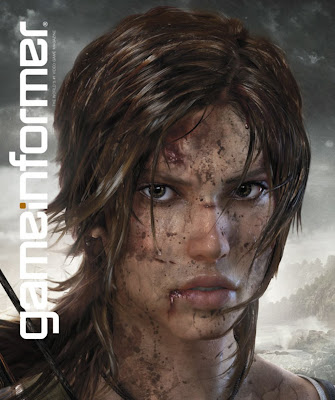
The accompanying article, written by Meagan Marie, expertly summarized Crystal Dynamic's reasoning's behind the new direction for the franchise, Lara's new look, and the first few moments of game play. I would highly recommend reading the pre-game play part of the article if you can find it as Meagan - while explaining to us the improvements to Lara's character - makes some good points about what it takes to create an interesting character, rather than just a strong, yet hollow character.
 A few notes about Lara's new look:
Brian Horton, the Senior Art Director for Crystal Dynamics says that Lara was redesigned from the inside out, rather then taking the original Lara and trying to fit her into a new perspective. This Lara is meant to be thought of as a character, a person that you can relate to, rather than an untouchable sex symbol. In fact, there is special emphasis in the article that a great deal of time went into Lara's eyes, which they were apparently successful at. From the article; "Eye tracking studies of the new Lara versus the old revealed that instead of looking at Lara's arsenal of curves, most participants spent their time gazing at her piercing brown eyes."
Another interesting change to the franchise is that while it still technically fits under the realm of the action adventure genre, Crystal Dynamics is referring to the game as "action survival." The images that accompany the article are dark, and somewhat disturbing. Bodies hanging upside down in burlap sacs, or strung stigmatically over burning candles. Lara seems to be covered in more blood than her usual dirt, and the descriptions of the ways that Lara can kill or hurt herself within the first fifteen minutes of the game make it apparent that the game will be M rated.
While I'm concerned about the M rating, which may stop me from purchasing the game, the article in Game Informer made Crystal's next installment out to have the characteristics of the types of games I want to support on this blog. I've ignored all the Tomb Raider games before Legends, because they seemed to have little more to offer than... well... a curvy woman in short shorts and a tank top. However, after I played Legends at a friend's house (after I had beaten nearly every other game that he owned), I realized that Chrystal Dynamics was building upon what was already there, and adding something of their own. I always felt that behind each scripted puzzle, there was a sense of freedom and adventure. Behind the death of each human there was a moral, or a warning trying to be made. There was something to be said for the fact that most of the enemies were non-human. Unfortunately these contributions were thrown off by making unlockable costumes and bikinis the motivation for replaying the game, or when you control Lara as she effortlessly and shamelessly kills every living person in the second level of Underworld. But there was always a sense that Chrystel Dynamics was trying to express something, which I feel is expressed in these words from Meagan:
To build Lara Croft into a culturally relevant hero worthy of the attention that once came so effortlessly, Crystal must break her first. This Lara isn't a shadow of the predecessor, nor the game a precursor to her later adventures. While she echoes the intelligence, strength, and beauty of Teflon Lara, she is a woman all her own. This Lara won't be invincible. She bleeds and bruises, trembles and cries, but ultimately pushes forward. Her coy and knowing smile may have been replaced with a grimace of pain and fear, but it's all part of the process.
Well, now all I can think of is that all this time I could have spent working on my project instead of writing this. So it might be a while before I write anything substantial again. ^_^
____________________________________________________
* Self Reference, or Recursive Link?
**Here is the comment that accompanied my Facebook post on the subject: "Supposedly Leaked Tomb Raider Concepts... looks like the Dead Space aliens crash landed in the middle of a Renaissance festival that Lara was attending in Silent Hill..." Called it!
Monday, September 6, 2010
How to Compile a GLUT Application in Eclipse
After a week of research, trail and error, and plenty of building and cleaning, I've finally figured out how to get GLUT to compile in Eclipse. Here are the steps that I used, however, unlike most of the "I finally got this to work so here is how I did it" posts I found out there that described this process, I will include as many relevant links as I can at the end of this post. I will also try to explain why we are doing the steps, so that if you have to trouble-shoot it yourself you will understand what you are doing:
1. Download Eclipse Wascana. This is an Eclipse IDE that is already set up with the C++ plugins, the CDT (C/C++ Development Tooling) and the correct version of MinGW (a C++ compiler) and the tools that it uses. This will install in your C: directory and will also add your mingw directory (C:\Wascana\mingw) to the system path. By downloading Wascana you're saving somewhere around 5-10 additional installation steps :)
2. Start Wascana. Go to File -> New -> C++ Project. Under Project Type go to Executable -> Empty Project. IMPORTANT: Under Toolchains select MinGW GCC. If MinGW GCC is not selectable and you are only showing toolchains that are supported in your system, then you probably didn't follow step 1, and you installed MinGW incorrectly on your own version of Eclipse. You will need to reinstall at the above MinGW site.
3. Create a new .cpp file in the root directory of your project. For a quick test I used this one.
4. Download GLUT 3.7.6 here.
5. Once you've unpacked the zip file (containing the .h, .lib and .dll, not the source files) you will want to create a new directory in the root of your C++ project called 'GL'. Copy the glut.h file there. MinGW will also need a copy of glut.h in order to compile correctly. Copy glut.h to C:\Wascana\mingw\include\GL.
6. Optionally, you can create another directory in the root of your project called 'lib'. Add the glut.lib file you just unpacked in your GLUT download to the directory However, this does not add the library to your project! THIS PART IS NOT OPTIONAL: To add the library to your project right click on the project and go to properties -> C/C++ Build -> Settings. Then under Tool Settings go to MinGW C++ Linker -> Libraries. Add glut32, glu32, opengl32 one at a time to the Libraries. You will need to do this for every GLUT project that you create. Also, MinGW comes with the opengl and glu libraries, but you will need to specify where the glut32 library is stored. Add a new Library search path below the libraries. Press the "File System..." button and navigate to and add the lib directory we just created, or add the directory where you chose to keep the glut32.lib file.
7. Now add the glut32.dll to a directory where your system will look for it. For XP users, put it in 'C:\Windows\System32'. if you are using a Vista or Windows 7, my understanding is that you should put it in 'C:\Windows\SysWOW64'. For my Windows 7 machine I put it in both directories, just to be safe. *shrug* Also, you will need to add the .dll file to the root of your C++ project.
8. If you cleaned your code now, there is a possibility that your code might work fine. However myself and many of the people on the forums seemed to get an error at this point that said something like:
undefined reference to `__glutCreateWindowWithExit'
If you get this, then you will need to add one or both of the following lines to your .cpp file before you include glut.h:
#define GLUT_DISABLE_ATEXIT_HACK
#include <windows.h>
undefined reference to `__glutCreateWindowWithExit'
If you get this, then you will need to add one or both of the following lines to your .cpp file before you include glut.h:
#define GLUT_DISABLE_ATEXIT_HACK
#include <windows.h>
Now you should be able to clean your project without any errors. When I tried to build it would say that there was nothing to build, but after cleaning I could right click and run as a Local C++ app.
If you continue to have problems, here are some sites that I found helpful:
Also, I tried to get GLUI to compile in Eclipse. It's impossible. GLUI was built using Microsoft Visual C, and therefore does not get along with MinGW. I'm not sure if there's a way you can build the source using MinGW, but for as many times as I saw this mentioned as a possible solution by the know it alls of the development forums to anyone who was trying to get it to work, I never saw anyone who claimed to be successful at it. But then again, I hadn't seen anyone who had attempted to try it either. I gave it a shot and it quickly looked like if it was possible that it was going to take just as long if not longer to figure out as getting GLUT to work, so for the sake of my sanity and marriage, I didn't pursue it any further than that.
There are supposedly newer and better tools that can be used instead of GLUI. If I find a good substitute, I will post it here.
Good Luck!
Tuesday, August 10, 2010
Lovely Lady Bump Maps
My eyes were immediately drawn to the cover of the GameInformer magazine peeking from under a stack of mail on my kitchen table when I came home this afternoon. Before I knew what the game on the front cover was I knew I loved the design, and had tried my hand at it frequently in my drawings in the past. Black and White. Strong Highlights. Dark Shadows. Due to the topics' iconic ears I quickly recognized the game to be the sequel to Batman: Arkham Asylum. However even while my subconscious was making these connections in the back of my mind, my first real thought when looking at this picture was "Wow! Look at Catwoman's bump map!"


That's all for now. I have some other 3D projects I'm working that I hope to be able to post soon that should be WAY more exciting, so be sure to keep an eye open!

Bump maps have been being used for at least a few years now to make models look more detailed without having to model all of those details. For example, the mesh patterned shadows on Catwoman's outfit, or the criss-cross lines, seams bolts and possibly even the beveled logo on his chest are all made to look like they were modeled in 3D using bump maps.
I have read a lot about bump maps, had a fair idea of how to implement them in Blender, but had never actually done it before. While I hear it's bad form to post test renders rather than actual pieces of art, I still thought I would post these anyway, just for fun. I mean... I haven't posted anything else in a while anyway...

If you came across this trying to learn how to implement bump maps yourself, here is a quick how-to for Blender 2.49:
1. Create an object.
2. Add a new material under the material panel.
3. Create a custom texture for that material under the texture panel. This texture is Veroni: W1=0.884, W2=-0.810, all others are default.
4. Go back to the material panel. Under the Map Input tab press the "Nor" button.
5. Under the Map To tab, deselect the "Col" button, and press the "Nor" button. Click it once for regular mapping (text is white) or twice for negative mapping (text is yellow).
6. Adjust the "Nor" slider to your satisfaction. The bump mapping isn't very impressive at 0.00. (In this example the value is equal to 11.31).
Other settings of note. There are two default lamps, and one spotlight in the scene. Material color is a very light gray. Diffuse shader is Lambert: Ref=0.496, Specular Shader is Toon: Spec = 0.153, Size=0.323, Smooth=0.10. There is also a Spec Ramp, first color is clear (alpha = 1) and second color is white positioned at 0.690 on the colorband.
Finally, here is Suzie doing a very bad Catwoman impersonation, but doing a good job of demonstrating a combination of smooth and bumped materials on the same mesh. Joey and Kimmie thought I was trying to make Bugmonkey:

Saturday, June 5, 2010
Apostrophes in JSPs
I recently came across an interesting problem trying to
c:out Strings containing apostrophes in a JSP generated web page. Let's say you had a call to a JavaScript function -- similar to the one below -- that was called when an html component was clicked and the parameters were populated by JSP
c:out tags:onclick = "doSomething('<c:out value="${text}">')"As you can see, when the variable
text contains an apostrophe, it will close the parameter String for doSomething early, causing the rest of characters in text to be read as uncompilable code.Now I don't claim to be a JSP/Javascript/HTML ninja, so there may be a more obvious solution then the one I eventually arrived to. But due to the number of people I found asking for solutions to problems like this online, and the lack of finding the solution I eventually arrived at, I thought this was worth sharing.
The solution that I found on numerous sites was to use escape characters to display the apostrophe. In my Tag on the server side I replaced the apostrophe in the
text variable with something like this:text = text.replaceAll("'", "\\\\'");That's one escape character to tell JSP to display the apostrophe instead of using it to close the sting, another escape character to put in front of that escape character to tell Java that you want to pass an escape character, and another escape character in front of each of those escape characters because
replaceAll uses regular expressions to find and replace your substrings. This worked fine, but even as I released it it felt flimsy to me, and in when tested on another environment, was still throwing an error unless another escape character was added. I couldn't find the discrepancy between the two environments, but this was proof enough for me that it was not a solid enough fix. It seemed to me that if on a different environment our string went through some additional protocol that uses backslash as a character escape, then it would mess up the whole code.The solution I found was to substitute HTML codes for the escape character and the apostrophe:
text = text.replaceAll("'", "\''");
where
\ is the HTML code for the "\" and ' is the HTML code for an apostrophe. Using these character codes, we can bypass any code that might process our escape characters and break our code before it gets to our page.However, by default JSP will convert our HTML codes, process the character break and display an apostrophe, thus defeating our original purpose in replacing the apostrophe. This can be disabled per
c:out tag by setting the escapeXML tag to falseonclick = "doSomething('<c:out value="${text}" escapeXML = "{false}">')"If you view the source, you will wee the HTML codes used in your String instead of an apostrophe. If you want the apostrophe to display, just don't add the
escapeXML = "{false}" parameter.Thursday, May 13, 2010
With Great Power...
It's almost scary how much power one person can have on the internet. Below is today's xkcd:

And here is the pandemonium that ensued on Wikipedia.
I sometimes wonder what it would be like to have a presence like that on the internet, and if it's a good thing or a bad thing. I always imagine Munroe sitting in a dark room, twisting his mustached and laughing manically to himself whenever he submits a new web-comic to his site. Then sitting back in his padded chair the next morning with a hot cup of coffee and a pleased smirk on his face after performing a quick Google search to view the resulting mayhem.
I sometimes wonder what it would be like to have a presence like that on the internet, and if it's a good thing or a bad thing. I always imagine Munroe sitting in a dark room, twisting his mustached and laughing manically to himself whenever he submits a new web-comic to his site. Then sitting back in his padded chair the next morning with a hot cup of coffee and a pleased smirk on his face after performing a quick Google search to view the resulting mayhem.
Wednesday, January 6, 2010
Holiday Cheer
nother part of gaming I hope to share from time to time is game development, something that I dabble in from time to time and hope to dive into much stronger in the future. However one of my favorite parts of game design is character design which stems from an interest in drawing that I've had as a child.


Eventually I would like to share with you some things I've learned about character design and share with you the development of a character that I've been working on for years. But today, I just want to share with you an exciting new tool I've received as a Christmas present from my mother-in-law. She got me this graphics tablet, which is basically a pad that allows the user to draw with a pen rather than a difficult to use mouse on the computer.
I've had some experience coloring my drawings using Photoshop and the Gimp before, one of my least favorite parts was having to draw the picture, scan it and then either having to find single whit pixels in the middle of black lines or having to retrace the drawing. When I draw th image directly on the computer I instantly have an inked drawing, which cuts out a whole extra step in the drawing process. Here is the inked drawing:

Another thing that I liked about drawing in The Gimp directly with a graphics table was that I could draw a light rough sketch on one layer, and then draw the image on top. This means instead of having to erase a bunch of pencil marked circles and guidelines, all I have to do is delete the layer.
Some of my past experiments with coloring that you can see on my website involved basically coloring everything flat, and then creating a highlight and shadow color for each color on the image. Recently I've been looking at a lot of american comic drawings, and was really impressed with their "airbrush" style coloring, which was actually using lots of gradients to blend highlights, shadows, and then to create brighter highlights and darker shadows on top of those. I think it makes the image pop more. Here is my attempt at that type of coloring:

Unfortunately, before learning how to use gradients to color I first tried using the airbrush, which is how I colored the hair and her black leotard. I feel it made the hair look more like a blob, and the black clothes look too shiny. But for the most part, I feel happy with the way it turned out. I was specifically excited about the way the highlights turned out on the bow on her back, and the way I was able to shade the back leg so the it literally looks below and behind her.
Looking at it now, I feel like I could have spent some more time lightening some of the highlights and darkening some of the shadows. I've also seen some images that have some really good examples of secondary lighting, that can add even more dimension to a drawing, but for now, I'm pretty happy with this first attempt and coloring with gradients.
Wednesday, December 9, 2009
Welcome Back
So, my original goal when I started this blog was to post once a week so I could make it a blog worth following... oops.
But, I just watched this video on ign about Final Fantasy XIII, and I was surprised when I thought I heard them say that the main theme song was going to be by Leona Lewis, so I rewound the video and listened again... and yeah, that's what they said, Leona Lewis. I was immediately frightened with the idea of an overly dramatic love song like Bleeding Love or Better In Time being the main theme song for a Final Fantasy game. I mean, come on, that's just not Final Fantasy!
And then I realized... "Oh wait, yeah it is..." plus I have Better In Time thumbed up on one of my Pandora Stations. So naturally the first thing I did was do a Google search to hear the song, so enjoy... or not, your choice:
But the purpose of this blog is of course never just to keep you informed. It's to inform you about how I feel on a subject! After listening to the song, I looked down at all the comments (2,644 at the time I'm writing this) and was somewhat shocked to find all the negative feedback it's received:
"...her singing in the song makes it out of place in FFXIII." ~hasseo543
"Lyrics don't fit for the game. Good song, but not right." ~LastDanceUp
And my personal favorite:
"i dont like how this song start its freaking retard n it dont make scene how the **** would anyone think this song would match final fantasy game if they do its their bigest mistk" ~4199232
Feeling (as most people on the internet do) that these people needed to be educated about the facts of Final Fantasy life, I attempted to add my own comment, only to find that I first was required to sign up for a YouTube account. Fair enough, I sign up for accounts that I plan on only using once all the time. Unfortunately, there must be some feud that I thought I remember hearing about in passing, between YouTube and Google as the first thing YouTube did before asking me what snazzy nickname I would be referring to myself as (I was thinking the best choice to show everybody how clever I was would be a bunch of random numbers) was to log out of my Google account. And that's when I realized what a Google fanboy I am... because I thought "That's not worth it to me. I use Chrome, I'm constantly logged into my iGoogle and my Wave. If I logged out, what would happen the next time I started my browser! I would have to re-sync all my bookmarks, log back into my iGoogle!" Internet chaos would ensue, and the collateral damage seemed to great a cost.*
But, if I had signed up for a YouTube account, and I did share my opinion with them, I would have pointed out to them that if the first time they had heard Final Fantasy VIII's Eyes On Me, Kingdom Hearts' Simple and Clean or Legend of Dragoon's If You Still Beleive** (all three main theme songs for an RPG and all three with English lyrics) hadn't been at some pivotal moment of an epic romance, or used as the final word and reminder of an epic adventure, love story or battle that you personally experienced enjoyed and learned from, would you still like those songs as much as you do now? As human we're very good at coupling sounds, images, and smells with experiences. When you hear a song from one of you're favorite video games, more than likely (at first) you're not actually appreciating the melodies and harmonies of the song as much as you're remembering all of your epic struggles, either alone or with virtual loved ones.
So what's my opinion on the song? As a song, I think it's ok, but I don't think I'll have a real opinion of it until I see and feel what experiences are coupled with it. I do however find it an interesting (and exciting) move for Square-Enix to get such a mainstream and popular American entertainer to write and perform their main theme song.
then I would have told them that if their nickname was in fact referring to a US Patent then they should have a better understanding of how important their public internet appearance is than what they portrayed in their YouTube comment.
______________________________________________________________
*That won't seem as funny when it's not 1:30 in the morning and I'm struggling to even think straight at work for the rest of this week... >_<
**feel free to replace these songs with any of your favorite video game songs that you would not have liked if you had heard somewhere else first
Saturday, October 17, 2009
Things I’ve Learned From Video Games Part II
You all knew that this day would come. Perhaps, however, it's a little detrimental to my cause to note that the prequel to this blog was posted over six months ago.
But that doesn't mean that there are not a lot of things to learn in video games. It's kind of like any other form of art, most things that you experience in a video game can't really be shared by explaining what happened, but by going through the experience yourself. I've kinda stopped telling the genereal public (although I'm admitting it here) that I cried when Aeris died in FF7. Because although we can all understand someone getting a little teary eyed after reading a book like "Where the Red Fern Grows", or a person who cried in the final minutes of Titanic, nobody can seem to understand the concept of becoming just as emotionaly involved with a video game.
But I digress...
The point is, it's not hard to find artistic beauty in video games, or any other medium I should mention. The challenge is finding snidbits of video games that can be recognized as contributions to the human race without having to go through the whole experience.
So I think one of the most influential video games for me may be the Metal Gear Solid series. Metal Gear Solid is described on the cover as "Tactical Espionage Action" and involves sneaking around. The storyline is mindblowing, and spans from the 1960's to 2014, and involves giant robots that can shoot nuclear missles, clones, possesions through arm transplants, and secret societies that run at least three of the major world governments. Believe me, it sounds silly, but really, amazing game.
So how could something that sounds so... incredible?... be of any significant value to our society? Well, I think one of the most important aspects is that it has a sort of respect for life. In most of Snake and Raiden's Missions they are usually encouraged to sneak past the enemy in order to avoid being discovered, rather than shooting everybody in the head. Your inventory does not only include AKs and C4, but you usually have the option of using a traquilizer gun, or a stun grenade, rather than a video game's usual tools of distruction. But a tranquilizer is so much slower and harder to use, why would anybody want to use that?
I think for me, the answer to that was demonstrated in Metal Gear Solid 3: SnakeEater.
One of my favorite things to do in SnakeEater when I first started playing it was to sneak up behing an enemy, grab him and slit his throat... yeah... again sounds detrimental to my cause right? Just wait a moment. Anyway, I would go out of my way to do this move, even though it's harder to do than to shoot an enemy, or even just to break his neck. So needless to say, I had done this to a lot of poor unsuspecting Russian gaurds.
Near the end of the game, you run into a guy named The Sorrow. He's already dead, but when he was alive he acted as a medium between the world of the living and the world of the dead. As you are forced to walk slowly towards him down a river, every single enemy that you have killed in the game walks down the river towards you, screaming about the pain, head rolling on their shoulder if their neck was broken, hanging by the skin if their throat was slit. I suddenly realized that by killing so many people, I had made it harder for myself here at this point of the game. Then as the scientists began walking down the river towards me I realized that most of these people I didn't even need to kill. Almost amusingly, and perhaps because I'm a "sensitive guy" I began to think to myself that in real life, when wars are fought, the "bad guys" that we fight against are only fighting for their country. They may not even be fighting for the same cause as their leaders, but only becasue they believed in their homelands, just as we do. Back home, they have friends, family, religions, goals, dreams. Those are the kind of people fighting on the battle field, on both sides. When they die, somebody back home is sad.
I'm not sure if that is what Hideo Kojima, the creator of the Metal Gear series really had in mind when he wrote that aspect of the game, but I wouldn't be surprised if he did. To me, he's like the Steven Speilburg of video games, because not only does he intend to enterertain, but he intends to make us think. Becauae of Kojima, evertime I raise a gun in a video game I instinctively think about that soldier's family. I suddenly think of it as a person, and I try to come up with other ways to get past the situation... even if it means losing a little bit of health. (that sounds ridiculous... what a sacrifice, huh? lol)( come to think of it, however, I don't play very many game in which the enemies are human beings)(Metal gear Solid may be the only game I own in which the enemies are human... and as I'm explaining, there are plenty of ways to get out of killing).
But then again... what do I know. Jack Thompson will tell you all I'm doing is "training" by playing my "Murder Simulators." Be careful, I may be the next one to break, as scary as I am.
But this is what I am trying to get to. This is why I want to make video games, becasue games are another medium in which feelings, emotions, and beliefs can be expressed. In my literature class in high school, my teacher distilled upon me the idea of immortality in a way I had never thought of it before. Everybody wants to be immortal, but we all die. All that we can hope for is to be remembered. William Shakespeare is immortal in the sense that everybody knows who he is, and what he did, although perhaps only a few of us have enjoyed his work as we should. Perhaps the rising generation of gamers will not play Final Fantasy 7 becuase the 1997 state of the art graphics are now considered obsolete, and perhaps the next generation of gamers will never play Metal Gear Solid for the same reason. Or perhaps there are people who have played these games and only enjoyed them for their gameplay. But somewhere, when Kojima, of Sakaguchi and many others die, hopefully they will live on through their contributions. That's why I want to be a game designer. Silly as it sounds, I hope to someday touch someone for the better, the way that some of these games have had a small positive impact on myself.
In closing, I want to leave with you the quote that inspired this blog. It's a monologue given by Snake at the end of Metal Gear Solid 2: The Sons of Liberty. A major theme of the game was the passing on of information, and how do we know what should or shouldn't be passed on. Snake talks about the importance of "Passing on the Torch" or in my own words, passing on our immortality.
"Life isn't just about passing on your genes. We can leave behind much more than just DNA. Through speech, music, literature and movies... what we've seen, heard, felt ...anger, joy and sorrow... these are the things I will pass on. That's what I live for.
We need to pass the torch, and let our children read our messy and sad history by its light. We have all the magic of the digital age to do that with. The human race will probably come to an end some time, and new species may rule over this planet. Earth may not be forever, but we still have the responsibility to leave
what traces of life we can. Building the future and keeping the past alive are one and the same thing." Solid Snake, Metal Gear Solid 2: Sons of Liberty
But that doesn't mean that there are not a lot of things to learn in video games. It's kind of like any other form of art, most things that you experience in a video game can't really be shared by explaining what happened, but by going through the experience yourself. I've kinda stopped telling the genereal public (although I'm admitting it here) that I cried when Aeris died in FF7. Because although we can all understand someone getting a little teary eyed after reading a book like "Where the Red Fern Grows", or a person who cried in the final minutes of Titanic, nobody can seem to understand the concept of becoming just as emotionaly involved with a video game.
But I digress...
The point is, it's not hard to find artistic beauty in video games, or any other medium I should mention. The challenge is finding snidbits of video games that can be recognized as contributions to the human race without having to go through the whole experience.
So I think one of the most influential video games for me may be the Metal Gear Solid series. Metal Gear Solid is described on the cover as "Tactical Espionage Action" and involves sneaking around. The storyline is mindblowing, and spans from the 1960's to 2014, and involves giant robots that can shoot nuclear missles, clones, possesions through arm transplants, and secret societies that run at least three of the major world governments. Believe me, it sounds silly, but really, amazing game.
So how could something that sounds so... incredible?... be of any significant value to our society? Well, I think one of the most important aspects is that it has a sort of respect for life. In most of Snake and Raiden's Missions they are usually encouraged to sneak past the enemy in order to avoid being discovered, rather than shooting everybody in the head. Your inventory does not only include AKs and C4, but you usually have the option of using a traquilizer gun, or a stun grenade, rather than a video game's usual tools of distruction. But a tranquilizer is so much slower and harder to use, why would anybody want to use that?
I think for me, the answer to that was demonstrated in Metal Gear Solid 3: SnakeEater.
One of my favorite things to do in SnakeEater when I first started playing it was to sneak up behing an enemy, grab him and slit his throat... yeah... again sounds detrimental to my cause right? Just wait a moment. Anyway, I would go out of my way to do this move, even though it's harder to do than to shoot an enemy, or even just to break his neck. So needless to say, I had done this to a lot of poor unsuspecting Russian gaurds.
Near the end of the game, you run into a guy named The Sorrow. He's already dead, but when he was alive he acted as a medium between the world of the living and the world of the dead. As you are forced to walk slowly towards him down a river, every single enemy that you have killed in the game walks down the river towards you, screaming about the pain, head rolling on their shoulder if their neck was broken, hanging by the skin if their throat was slit. I suddenly realized that by killing so many people, I had made it harder for myself here at this point of the game. Then as the scientists began walking down the river towards me I realized that most of these people I didn't even need to kill. Almost amusingly, and perhaps because I'm a "sensitive guy" I began to think to myself that in real life, when wars are fought, the "bad guys" that we fight against are only fighting for their country. They may not even be fighting for the same cause as their leaders, but only becasue they believed in their homelands, just as we do. Back home, they have friends, family, religions, goals, dreams. Those are the kind of people fighting on the battle field, on both sides. When they die, somebody back home is sad.
I'm not sure if that is what Hideo Kojima, the creator of the Metal Gear series really had in mind when he wrote that aspect of the game, but I wouldn't be surprised if he did. To me, he's like the Steven Speilburg of video games, because not only does he intend to enterertain, but he intends to make us think. Becauae of Kojima, evertime I raise a gun in a video game I instinctively think about that soldier's family. I suddenly think of it as a person, and I try to come up with other ways to get past the situation... even if it means losing a little bit of health. (that sounds ridiculous... what a sacrifice, huh? lol)( come to think of it, however, I don't play very many game in which the enemies are human beings)(Metal gear Solid may be the only game I own in which the enemies are human... and as I'm explaining, there are plenty of ways to get out of killing).
But then again... what do I know. Jack Thompson will tell you all I'm doing is "training" by playing my "Murder Simulators." Be careful, I may be the next one to break, as scary as I am.
But this is what I am trying to get to. This is why I want to make video games, becasue games are another medium in which feelings, emotions, and beliefs can be expressed. In my literature class in high school, my teacher distilled upon me the idea of immortality in a way I had never thought of it before. Everybody wants to be immortal, but we all die. All that we can hope for is to be remembered. William Shakespeare is immortal in the sense that everybody knows who he is, and what he did, although perhaps only a few of us have enjoyed his work as we should. Perhaps the rising generation of gamers will not play Final Fantasy 7 becuase the 1997 state of the art graphics are now considered obsolete, and perhaps the next generation of gamers will never play Metal Gear Solid for the same reason. Or perhaps there are people who have played these games and only enjoyed them for their gameplay. But somewhere, when Kojima, of Sakaguchi and many others die, hopefully they will live on through their contributions. That's why I want to be a game designer. Silly as it sounds, I hope to someday touch someone for the better, the way that some of these games have had a small positive impact on myself.
In closing, I want to leave with you the quote that inspired this blog. It's a monologue given by Snake at the end of Metal Gear Solid 2: The Sons of Liberty. A major theme of the game was the passing on of information, and how do we know what should or shouldn't be passed on. Snake talks about the importance of "Passing on the Torch" or in my own words, passing on our immortality.
"Life isn't just about passing on your genes. We can leave behind much more than just DNA. Through speech, music, literature and movies... what we've seen, heard, felt ...anger, joy and sorrow... these are the things I will pass on. That's what I live for.
We need to pass the torch, and let our children read our messy and sad history by its light. We have all the magic of the digital age to do that with. The human race will probably come to an end some time, and new species may rule over this planet. Earth may not be forever, but we still have the responsibility to leave
what traces of life we can. Building the future and keeping the past alive are one and the same thing." Solid Snake, Metal Gear Solid 2: Sons of Liberty
Friday, October 16, 2009
Things I've learned From Video Games... Part I
Things I've learned From Video Games... Part I
Current mood: contemplative
Cause I'm sure this won't be the last.
So I'm a nerd. We had a reception today at the hotel while I was at work. It was an old... I shoudl say acquaintence of mine... Nobody that I've ever really talked to all that much, but her family goes to our ward. Anyway, she's like younger than my little sister, and getting married. That and the fact that I will be going to church tomorrow and sitting with my family... and I will be the only one there without a spouse and either a child or one on the way. All these things caused me to pause and reflect upon my current life, Dicisions I've made in my past and where I am because of it, and what I plan to do about it. So what do I do? I look up a translation of the Final Fantasy VII Ultimania Omega. A book that tries to explain all thing Final Fantasy VII.
Through my search I found a few various quotes from the producers and writers of the game. From them, this is what I have learned.
Quoted from the below site Tetsuya Nomura, the greatest Character Designer in the world (although Kai thinks that he puts on way to many buckles on his characater)(but I think the more the marrier.)(in fact many of my drawings have been inspired by Tetsuya Nomura, the first one that comes to my mind is Kali) Anyway so Tetsuysa Nomura, the greates Character Designer in the world and Yoshinori Kitase, the Director and Co-Scenario writer of FFVII said this concerning Aeris's death and revival:
Nomura said :"Back at the time we were designing the game, I was frustrated with the perennial cliche where the protagonist loves someone very much and so has to sacrifice himself and die in a dramatic fashion to express that love. We found this was the case in both games and movies, both eastern and western. But I wanted to say something different, something realistic. I mean, is it right to set such an example to people?"
Kitase's follow up to Nomura's comments: "In the real world, things are very different. You just need to look around you. Nobody wants to die that way. People die of disease and accident. Death comes suddenly and there is no notion of good or bad attached to it. It leaves, not a dramatic feeling, but a feeling of emptiness. When you lose someone you loved very much you feel this big empty space and think 'If I had known this was coming I would have done things differently.' These are the feelings I wanted to arouse in the players with Aerith's death relatively early in the game. Feelings of reality and not Hollywood."
I was once told by my literary teacher that literature is the study of human behavior. Why else would you think that it would be important to study it in high school? It gives us a greater understanding of people's opinions of how one should react to different situations. Apparently Science Fiction was used as a tool to make a moral point that was best emphasized by showing characters in extreme sitiations. So why do video games not fit into that same category that literature does? A majority of today's "gamers" do not play video games only for the game experience, any more than most people don't see a movie just for the special effects. Sure, they're nice, but what really makes a movie or a video game great is the story that is behind it.
Would you believe me if I told you that I have played games that have inspired me to do and be someting more?
On that note, I just want to leave you with a quote, again from the writer of the above mentioned article wich is linked below:
"If you take anything from any of this stuff to heart, take the one ideal of
Final Fantasy that its creator sought to illustrate: Life's about experiences,
about making memories. The more you do and experience, the more you grow, and the more the world around you grows. We're all part of a big interrelated environment that's about that: Growth. Call it a web, or a ship, or a zoo if you want to, but just do it. The most important thing in life is showing up for it."
http://db.gamefaqs.com/portable/psp/file/final_fantasy_vii_ac_plot.txt
Well, anyway, on that note, I will take my leave as one of the biggest nerds I know...
Current mood: contemplative
Cause I'm sure this won't be the last.
So I'm a nerd. We had a reception today at the hotel while I was at work. It was an old... I shoudl say acquaintence of mine... Nobody that I've ever really talked to all that much, but her family goes to our ward. Anyway, she's like younger than my little sister, and getting married. That and the fact that I will be going to church tomorrow and sitting with my family... and I will be the only one there without a spouse and either a child or one on the way. All these things caused me to pause and reflect upon my current life, Dicisions I've made in my past and where I am because of it, and what I plan to do about it. So what do I do? I look up a translation of the Final Fantasy VII Ultimania Omega. A book that tries to explain all thing Final Fantasy VII.
Through my search I found a few various quotes from the producers and writers of the game. From them, this is what I have learned.
Quoted from the below site Tetsuya Nomura, the greatest Character Designer in the world (although Kai thinks that he puts on way to many buckles on his characater)(but I think the more the marrier.)(in fact many of my drawings have been inspired by Tetsuya Nomura, the first one that comes to my mind is Kali) Anyway so Tetsuysa Nomura, the greates Character Designer in the world and Yoshinori Kitase, the Director and Co-Scenario writer of FFVII said this concerning Aeris's death and revival:
Nomura said :"Back at the time we were designing the game, I was frustrated with the perennial cliche where the protagonist loves someone very much and so has to sacrifice himself and die in a dramatic fashion to express that love. We found this was the case in both games and movies, both eastern and western. But I wanted to say something different, something realistic. I mean, is it right to set such an example to people?"
Kitase's follow up to Nomura's comments: "In the real world, things are very different. You just need to look around you. Nobody wants to die that way. People die of disease and accident. Death comes suddenly and there is no notion of good or bad attached to it. It leaves, not a dramatic feeling, but a feeling of emptiness. When you lose someone you loved very much you feel this big empty space and think 'If I had known this was coming I would have done things differently.' These are the feelings I wanted to arouse in the players with Aerith's death relatively early in the game. Feelings of reality and not Hollywood."
I was once told by my literary teacher that literature is the study of human behavior. Why else would you think that it would be important to study it in high school? It gives us a greater understanding of people's opinions of how one should react to different situations. Apparently Science Fiction was used as a tool to make a moral point that was best emphasized by showing characters in extreme sitiations. So why do video games not fit into that same category that literature does? A majority of today's "gamers" do not play video games only for the game experience, any more than most people don't see a movie just for the special effects. Sure, they're nice, but what really makes a movie or a video game great is the story that is behind it.
Would you believe me if I told you that I have played games that have inspired me to do and be someting more?
On that note, I just want to leave you with a quote, again from the writer of the above mentioned article wich is linked below:
"If you take anything from any of this stuff to heart, take the one ideal of
Final Fantasy that its creator sought to illustrate: Life's about experiences,
about making memories. The more you do and experience, the more you grow, and the more the world around you grows. We're all part of a big interrelated environment that's about that: Growth. Call it a web, or a ship, or a zoo if you want to, but just do it. The most important thing in life is showing up for it."
http://db.gamefaqs.com/portable/psp/file/final_fantasy_vii_ac_plot.txt
Well, anyway, on that note, I will take my leave as one of the biggest nerds I know...
Opening the Vortex
Like most people, I'm full of opinions that I think the world should be aware of. Of course, similar to most people's experience with their opinions, I've found that everybody else in the world is too preoccupied expressing their own opinions that they don't take the time to listen to mine. Fortunately there's a solution for people like us. Blogging! Thanks to blogging I can type out my opinions and submit them to the ether of the internet with the firm belief that -- while not highly probable, still possible -- my writings will actually be read by some random slider who stumbles across them while careening through wormholes of Google in search of inappropriate pictures of anime characters.*
(Oh, and friends and family, too. Thanks guys! ^_^)
The hope of this blog is to share with you my thoughts and feelings on the subject of video games within the scope of my experience. This includes game reviews, game development, game art, game moments and just having game in general. If it doesn't remotely fit into any of these categories then it will appear on the family blog that I have started working on for my wife months ago and was still preceded by this one which I started tonight.
I realize of course, that there are plenty of gaming blogs already in existence on the internet. The secret ingredient of this blog will be a strong emphasis on the good or bad contributions that games individually or specifically have on our society. Lets face it, we are now living in a generation in which games are no longer just for nerds**, but have become a mainstream media outlet in which opinions, beliefs and ideals can be expressed and suggested. Our children will be growing up in a world where video games are already common place, and as a result will be a greater and more accepted part of their lives that they were in ours. In short, video games have become to our generation what tv was to our parents generation, a source of not only entertainment, but of expression that was not readily accepted by the previous generation. Isn't it about time that we as a society -- as we did with tv, radio and literature in the past -- acknowledge the real effects this media can have on our society and augment the attributes that can have a greater positive effect?
I do hope that you're not expecting every post to be a deep insightful look at the philosophy of video games... more then likely they will be shallow insightful looks at best. But I will ask of every game that is reviewed on this blog "What contributions has this game contributed to our society?"
Plus I hope to have some fun and interesting comments to make along the way.
But to kick things off, I thought I could start by sharing some old posts from my old MySpace that I felt epitomize the goals of this blog that I outlined above. Enjoy!
Spacefly
____________________________________________________________________
*Well you won't find them here!
**But don't worry, the term nerd still applies to anybody who claims they've just "pwned" you.
Subscribe to:
Posts (Atom)